# About
Source: https://osbelgrade.mintlify.app/about
Learning poetry and Belgrade together: observations formatted as Python code, treating cultural experience as a system being logged and debugged.
## What is OS:B?
**Operating System: Belgrade** is a personal poetry collection disguised as code documentation. Or maybe it's code documentation disguised as poetry. Either way, I'm treating my experience - living in Belgrade for the first time - as if it were a software system being logged, debugged, and understood.
Each poem is formatted as a Python module, complete with class structures, timestamps, coordinates, and system metadata. The city becomes an operating system. My observations become function calls. My cultural confusion becomes error logging.
## Why?
I have two parallel learning processes happening here:
**Learning to write poetry** - Free verse, specifically. I'm capturing raw observations without forcing them into traditional structures. Using line breaks for pacing, trusting specific details over abstract statements, finding the shape that each observation wants to take.
**Learning to read Belgrade** - I arrived on September 30, 2025, unable to read Cyrillic, unfamiliar with the rhythms and rules of the city. Every day is new data. Every street corner is a new interface to understand.
The technical format isn't just aesthetic - it reflects how I experience this foreign city: as a system with unknown protocols, undocumented features, and surprising functions that only reveal themselves through direct observation.
## How I'm making it
My process:
1. **Observe** - Take raw notes throughout the day. Specific details, not summaries.
2. **Find the shape** - What's the natural arc? Where's the tension? What's the pivot point?
3. **Draft in free verse** - Let line breaks do work. Trust concrete images.
4. **Code it** - Format as a Python class with appropriate metadata.
5. **Categorise** - File into one of five modules based on thematic function.
My five modules:
* **Core Functions** - Fundamental experiences, arrival moments
* **User Interface** - Street life, human interactions, social systems
* **Background Processes** - Ambient city life, unnoticed patterns
* **System Errors** - Confusion, miscommunication, cultural glitches
* **Version History** - Evolution, learning, system updates
## Who I am
I'm one person, learning both poetry and Belgrade simultaneously. No prior poetry credentials. No expertise claimed. Just honest observation and a willingness to document the process of figuring both things out.
The technical format is my scaffold - it helps me organise observations when traditional poetic forms feel inaccessible. The coding metaphor makes the unfamiliar (poetry) approachable by framing it in familiar terms (systems, logging, documentation).
This is a beginner's project in every sense. That's the point.
## The Warsaw Winter Theatre Company
OS:Belgrade is a Warsaw Winter Theatre Company intervention:
Investigating Cultural Simulation, Authenticity and Performance in Place.
# Branding
Source: https://osbelgrade.mintlify.app/ai-tools/branding
Design principle: Every visual choice is also a conceptual choice. Nothing decorates. Everything documents.
## The Contemporary Approach
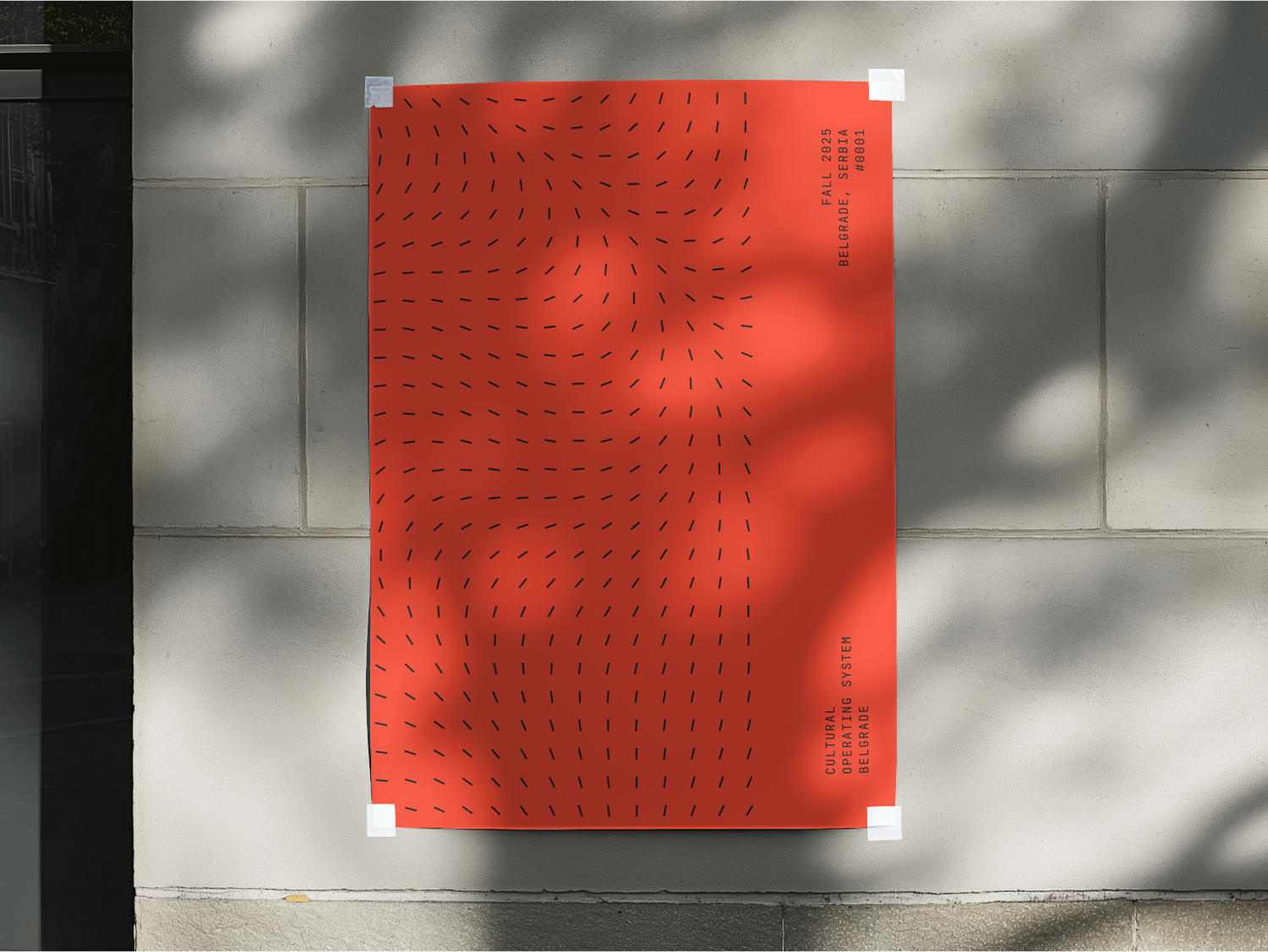
OS:B's visual identity doesn't follow traditional "poetry collection" aesthetics because this isn't a traditional poetry collection. The branding reflects the core concept: treating cultural experience as a technical system that can be documented, debugged, and understood.
## The Color System
**Primary: #ff4b33 (Red/Orange)**
This isn't purely decorative - it's functional. The red serves as:
* **The path through chaos** - A visual thread guiding you through complexity
* **Data highlighting** - What matters in the noise
* **System alerts** - Attention, observation, activation
* **Belgrade itself** - Bold, unapologetic, impossible to ignore
Contemporary branding uses color as information architecture, not just decoration. The orange doesn't prettify - it orients.
**Secondary: Black**
Pure contrast. No grey area. Binary. On/off. Observed/unobserved.
## The Pattern Systems
### Arrows
Directional data flow. System processes. Movement through Belgrade's chaos.
Most arrows are black (the city's movement), but the orange arrows trace **my path** - the user's navigation through illegibility. It's a visual representation of finding direction when you can't read the signs.
### Rotating Dashes
Observations accumulating. Rain falling. Data points.
The pattern transforms from vertical to horizontal with a **transition zone** - the moment of change, the pivot point, the corner where everything shifts (like the Waterworld poem).
These aren't decorative elements.
They're **data visualisations** of the learning process itself.
## The Icon System
**FontAwesome** is an open-source icon library providing scalable vector icons designed for web interfaces, developer tools, and technical documentation. The iconography is standardised, systematic, and ubiquitous in software development environments - instantly recognisable as belonging to digital/technical contexts.
For OS:B, FontAwesome icons reinforce the **technical documentation aesthetic** throughout both the Mintlify site and physical publication. Icons function as visual shorthand for system operations: location pins for coordinates, calendar icons for timestamps, code brackets for module categories, warning triangles for System Errors etc.
Using FontAwesome maintains **visual consistency** with developer tools and platforms while providing a **functional design language** that mirrors the project's approach - treating cultural observation as systematic documentation. The icons don't decorate; they **classify and organise**, operating as visual metadata that helps readers navigate the observation logs. FontAwesome's vector format ensures scalability across digital and print outputs, and its technical origins align perfectly with the subversion of developer tools for poetic purposes.
### Featured Navigation EIcons
### Chapters
Original Textual Content Repository Icons
### Codex
Extended Functionality Icons
### System
System Reference & Sharing Icons
### Admin
System Administration Icons
## The Textures
**Concrete + Digital**
Raw Belgrade (concrete, urban decay, socialist architecture) meets clean technical documentation (crisp typography, systematic layouts, code formatting).
This contrast **is** the experience - ancient city, modern tools; illegible streets, systematic observation.
Contemporary branding embraces these tensions rather than resolving them.
## The Typographic Philosophy
**Minimal. Technical. Precise.**
* Small identifiers (OS:B)
* System summaries (module names, timestamps)
* No flourishes
* Information hierarchy through size and weight, not decoration
The type doesn't perform.
It documents.
## The Meta-Approach
This branding **performs its own concept**.
Just as the poems are formatted as Python code, the visual identity uses technical/systems thinking:
* Patterns = `data`
* Color = `navigation`
* Layout = `structure`
* Design = `documentation`
It's not "poetry packaging."
It's a **visual operating system** for cultural observation.
## Why This Works Now
Contemporary audiences expect:
* **Honesty over polish** - Raw observation > curated perfection
* **Systems thinking** - Understanding how things work, not just what they look like
* **Multi-platform coherence** - Same logic works physically (publication) and digitally (Mintlify)
* **Conceptual integration** - Form follows (and reinforces) content
The branding doesn't ask you to appreciate poetry.
It asks you to **debug a city**.
***
# Claude Code
Source: https://osbelgrade.mintlify.app/ai-tools/claude-code
Claude Code is Anthropic's official CLI tool. This short guide will help you set up Claude Code to help you write and maintain further personal documentation.
## Prerequisites
* Active Claude subscription (Pro, Max, or API access)
## Setup
1. Install Claude Code globally:
```bash theme={null}
npm install -g @anthropic-ai/claude-code
```
2. Navigate to your docs directory.
3. (Optional) Add the `CLAUDE.md` file below to your project.
4. Run `claude` to start.
## Create `CLAUDE.md`
Create a `CLAUDE.md` file at the root of your documentation repository to train Claude Code on your specific documentation standards:
```markdown theme={null}
# OS:B documentation
## Working relationship
- You can push back on ideas-this can lead to better documentation.
Cite sources and explain your reasoning when you do so
- ALWAYS ask for clarification rather than making assumptions
- NEVER lie, guess, or make up information
## Project context
- Format: MDX files with YAML frontmatter
- Config: docs.json for navigation, theme, settings
- Components: Mintlify components
## Content strategy
- Document just enough for user success - not too much, not too little
- Prioritize accuracy and usability of information
- Make content evergreen when possible
- Search for existing information before adding new content.
Avoid duplication unless it is done for a strategic reason
- Check existing patterns for consistency
- Start by making the smallest reasonable changes
## Frontmatter requirements for pages
- title: Clear, descriptive page title
- description: Concise summary for SEO/navigation
## Writing standards
- Second-person voice ("you")
- Prerequisites at start of procedural content
- Test all code examples before publishing
- Match style and formatting of existing pages
- Include both basic and advanced use cases
- Language tags on all code blocks
- Alt text on all images
- Relative paths for internal links
## Git workflow
- NEVER use --no-verify when committing
- Ask how to handle uncommitted changes before starting
- Create a new branch when no clear branch exists for changes
- Commit frequently throughout development
- NEVER skip or disable pre-commit hooks
## Do not
- Skip frontmatter on any MDX file
- Use absolute URLs for internal links
- Include untested code examples
- Make assumptions - always ask for clarification
```
# Contextual Sharing
Source: https://osbelgrade.mintlify.app/ai-tools/share
Common Integrations using one-click AI integrations within OS:B
The contextual menu provides quick access to AI-optimised content and direct integrations with popular AI tools. When users select the contextual menu on any page, they can copy content as context for AI tools or open conversations in ChatGPT, Claude, Perplexity, or a custom tool of your choice with your documentation already loaded as context.
## **Menu options**
The contextual menu includes several pre-built options that users can enable by initialising any of the following options:
| **Option** | **Identifier** | **Description** |
| :--------------------- | :------------- | :----------------------------------------------------------------------- |
| **Copy page** | `copy` | Copies the current page as Markdown for pasting as context into AI tools |
| **View as Markdown** | `view` | Opens the current page as Markdown |
| **Open in ChatGPT** | `chatgpt` | Creates a ChatGPT conversation with the current page as context |
| **Open in Claude** | `claude` | Creates a Claude conversation with the current page as context |
| **Open in Perplexity** | `perplexity` | Creates a Perplexity conversation with the current page as context |
| **Copy MCP URL** | `mcp` | Copies your MCP server URL to the clipboard |
| **Connect to Cursor** | `cursor` | Installs your hosted MCP server in Cursor |
| **Connect to VS Code** | `vscode` | Installs your hosted MCP server in VS Code |
# Windsurf Code
Source: https://osbelgrade.mintlify.app/ai-tools/windsurf
Configure Windsurf's Cascade AI assistant to help you write and maintain further personal documentation.
## Prerequisites
* Windsurf IDE installed ([download here](https://codeium.com/windsurf))
* Active Codeium account (free or Pro)
## Setup
**Install Windsurf**\
Download and install Windsurf IDE from the official Codeium website.
**Open Your Documentation Project**\
Launch Windsurf and open your OS:B documentation repository.
**Configure AI Assistant**\
Windsurf's AI assistant (Cascade) is enabled by default. Access it via:
* Chat panel (right sidebar)
* Inline completions (as you type)
* Command palette (`Cmd/Ctrl + K`)
**Add Documentation Context (Optional)**\
Create a `.windsurfrules` file at the root of your documentation repository to train Windsurf on your OS:B documentation standards.
## Create .windsurfrules
Create a `.windsurfrules` file at the root of your documentation repository to establish OS:B-specific guidelines:
```python theme={null}
# OS:B Documentation Standards
## Project Context
This is OS:B (Belgrade Operating System) - a poetry project documenting Belgrade's
cultural operating system through technical documentation aesthetics.
All documentation must maintain technical manual voice while being accessible.
## Python Poetry Format
All poems follow this structure:
- 60-70 character line maximum
- Clean multi-line string in observe() method
- Metadata: location, timestamp, coordinates (in that order)
- Minimal footer only
- Free verse with intentional line breaks
## Documentation Voice
- Technical but not jargon-heavy
- Present tense, active voice
- Concrete observations over interpretation
- No romanticisation or performance of culture
## File Naming
Format: location-descriptor-YYYYMMDD
Example: oslobodjena-dusk-20241001
## Module Organization
- Core Functions: Essential Belgrade processes
- User Interface Studies: Navigation and interaction protocols
- Background Processes: Invisible cultural operations
- System Errors & Patches: Integration failures and debugging
- Version History: Historical protocol evolution
## Code Examples
Use bash for CLI commands, Python for poems and cultural algorithms.
All code must be functional and properly formatted for Mintlify rendering.
```
## Using Windsurf with OS:B
**Code Generation**\
Use Cascade to generate Python poem templates following OS:B standards. Reference `.windsurfrules` for consistent formatting.
**Documentation Editing**\
Windsurf provides AI-assisted editing for markdown content. Request changes like `update this section to match technical documentation voice` or `add bash code example for this installation step`
**Multi-file Context**\
Windsurf maintains awareness across your entire documentation repository, helping ensure consistency in terminology, structure, and formatting.
**Inline Assistance**\
As you write, Windsurf suggests completions that follow your established patterns and project conventions.
## Workflow Integration
**Creating New Observations**
1. Open new file with naming convention
2. Request: `Create OS:B poem template for [observation type]`
3. Windsurf generates structured Python template
4. Fill in metadata and poem content
5. Windsurf suggests line breaks and formatting improvements
**Updating Documentation**
1. Navigate to page requiring updates
2. Use Cascade chat to request specific changes
3. Review and accept AI-suggested modifications
4. Windsurf maintains consistency with existing style
**Troubleshooting** Ask Windsurf about Mintlify-specific syntax, navigation structure, or formatting issues. The AI can reference your entire project context to provide relevant solutions.
## Best Practices
**Context Loading**\
Open related files when working on connected documentation sections so Windsurf understands full context.
**Specific Prompts**\
Instead of "improve this," specify "rewrite in technical documentation voice maintaining 60-character line limit."
**Iterative Refinement**\
Use chat history to build on previous suggestions rather than starting fresh each time.
**Consistency Checks**\
Ask Windsurf to verify formatting consistency: "Check if all poem files follow the metadata order: location, timestamp, coordinates."
## Resources
* [Windsurf Documentation](https://codeium.com/windsurf/docs)
* [Cascade AI Features](https://codeium.com/windsurf/cascade)
* OS:B Technical Standards (see Knowledge Transfer document)
***
**Note**: While Windsurf can assist with code generation and documentation editing, it cannot observe Belgrade for you. The AI helps structure and format documentation - actual protocol discovery requires direct engagement with the city's operating system.
# Zora: Documentation Assistant
Source: https://osbelgrade.mintlify.app/ai-tools/zora
Zora is OS:B's integrated documentation assistant, embedded directly within the site to provide contextual guidance for navigating Belgrade's cultural operating system.
## System Overview
Zora is named after the Serbian "зора" (dawn/daybreak) and she functions as an intelligent query interface for users attempting to understand OS:B protocols documented throughout this site
**Note: Zora v1.0 was deprecated on 13.10.2025.** The current version is running on the Railway & Github code pathways but is not yet optimised for mobile viewports. We apologise for any inconvenience. Please check back for updates.
## Core Functionality
Zora processes natural language queries about OS:B documentation using agentic retrieval-augmented generation powered by Claude Sonnet 4. When users submit protocol clarification requests, Zora:
Retrieves relevant observations, protocol specifications, and system documentation to provide accurate contextual responses.
Links directly to referenced pages within OS:B modules, enabling users to examine full documentation context.
Creates executable code snippets demonstrating cultural protocol implementation based on documented observations.
Tracks frequently asked questions that may require additional protocol documentation or clarification.
## Accessing Zora
Three methods for initiating query interface:
**Keyboard Shortcut**\
`Cmd + I` (macOS) or `Ctrl + I` (Windows/Linux)
**Assistant Button**\
Located adjacent to foot of viewport
**Direct URL Parameter**\
Append `?assistant=open` to any OS:B page URL to launch Zora on page load
## Query Types Supported
Zora can assist with:
* **Protocol Clarification**: `"How does tram boarding actually work in Belgrade?"`
* **Module Navigation**: `"Show me observations about kafana culture"`
* **Technical Implementation**: `"How should I format a new observation entry?"`
* **Contextual Reference**: `"What does 'Belgrade volume' mean?"`
* **Cross-Reference**: `"Find all observations from Banjica district"`
* **System Architecture**: `"Explain the five module structure"`
## Limitations
Zora operates only on documented OS:B content. Questions about protocols not yet observed or documented will receive acknowledgment of documentation gaps rather than speculation.
Queries outside Zora's operational parameters are redirected to [david@reticulate.blog](mailto:david@reticulate.blog) for direct consultation.
Zora cannot access external Belgrade documentation or general travel resources. Responses derive exclusively from OS:B systematic observations.
## Query Analytics
OS:B monitors query patterns to identify:
* `Content gaps` requiring additional protocol documentation
* `High-traffic observation` modules indicating user interest areas
* `Unsuccessful query patterns` revealing documentation clarity issues
* `Common confusion points` needing enhanced explanation
These analytics inform ongoing documentation development and module expansion.
## Optimising Zora Interactions
* Specific protocol questions: `"What's the queue dissolution pattern for tram boarding?"`
* Module-specific searches: `"Find User Interface observations"`
* Technical implementation: `"Show me the Python template structure"`
* Questions requiring lived experience: `"What should I do in Belgrade?"`
* Speculation requests: `"Will I enjoy kafana culture?"`
* Content not yet documented: `"How do Serbian weddings work?"`
## Technical Architecture
Zora utilises:
* **Semantic Search**: Natural language processing for intent recognition
* **Contextual Retrieval**: RAG architecture accessing full OS:B documentation corpus
* **Source Attribution**: Automatic citation linking to referenced observations
* **Code Generation**: Python snippet creation following OS:B template standards
## Privacy & Data Usage
All queries are logged for documentation improvement analysis. No personal identification data collected beyond query content and timestamp.
Query analytics available for review in dashboard interface, exportable as CSV for analysis.
Zora operates within platform message allowances. Excessive usage may trigger temporary rate limiting.
## Integration with OS:B Methodology
Zora functions as meta-documentation layer - a system for navigating documentation about Belgrade's systems. This recursive structure mirrors the project's investigation of how we understand cultural operating systems through systematic observation.
Users encountering Belgrade's actual cultural software benefit from Zora's assistance navigating the documentation of that software. The assistant doesn't replace direct experience; it facilitates understanding of documented experience.
## Status & Availability
**Current Status**: `Operational`\
**Version**: `Integrated with Claude Sonnet 4`\
**Uptime**: `Continuous during platform availability`\
**Response Time**: `Near-instantaneous for standard queries`
***
## Building Zora: An AI Documentation Assistant
**Zora is a custom AI assistant built specifically for the OS:Belgrade documentation platform.**
Rather than relying on generic chatbots or off-the-shelf solutions, I developed Zora from the ground up to understand the documentation structure and provide accurate, contextual answers to user questions.
The technical architecture combines Claude's Sonnet 4.5 AI model with a custom Flask backend hosted on Railway. Naturally!
When you click "Ask Zora," your question is sent to the installation's API endpoint, which enriches it with knowledge about OS:Belgrade's features, structure, and capabilities before forwarding it to Claude.
This approach ensures Zora always responds with information specific to the platform rather than generic documentation advice. The widget itself is a lightweight JavaScript component that integrates seamlessly with Mintlify, featuring markdown rendering for clean, readable responses and conversation memory to maintain context across multiple questions.
I'm designing Zora with simplicity and accessibility in mind.
The distinctive orange "Ask Zora" button matches the brand identity and provides immediate access to help without disrupting a visitor's workflow. Whether you're looking for quickstart information, troubleshooting guidance, or details about specific features, Zora is trained to point you in the right direction.
As OS:Belgrade evolves, so will Zora - I'm continuously refining her knowledge base to ensure she remains a helpful companion on your documentation journey, starting with having her dynamically train herself as the site content is updated.
And there you have it!
**Note**: Zora cannot observe Belgrade for you. The assistant helps you navigate existing documentation - actual protocol discovery requires direct engagement with the city's operating system. Get out there and observe.
# Changelog
Source: https://osbelgrade.mintlify.app/changelog
Belgrade's operating system has undergone multiple major updates from political transitions and conflicts. Legacy code from previous versions remains active, layering over existing protocols. Current behaviour cannot be understood without reference to these accumulated system modifications.
## Notes on Version History
Each version implements fundamental protocol modifications that persist in current operations. Understanding version history is essential for interpreting why certain cultural behaviours, infrastructure decisions, and social patterns continue despite appearing obsolete or contradictory.
Legacy code from previous versions remains active in current implementation. OS:B does not deprecate historical protocols - it layers new systems over existing ones, creating complex backward compatibility requirements. Current Belgrade behaviour cannot be understood without reference to these accumulated system modifications.
This changelog documents significant version releases from 1945 to present, focusing on updates that permanently altered cultural operating parameters.
## Version History
```bash theme={null}
## OS:B Changelog
### Version 2025.10.16 (Current Release)
**Release Date:** October 2025
**Status:** Active Development
**New Features:**
- Added bespoke AI Assistant, "Zora" to replace deprecated Mintlify staff agent
**Deprecated:**
- Mintlify Staff Agent has been removed
**Known Issues:**
- Zora is still in training. She cannot dynamically scrape the site for updates due to security demands.
### Version 2025.10.07
**Release Date:** October 2025
**Status:** Active Development
**New Features:**
- Enhanced tourism protocols with increased English language support
- EU integration modules (partial implementation)
- Digital payment systems now available in major venues
- Gentrification detection algorithms for Savamala district
**Deprecated:**
- Full smoke immunity no longer required for all venues
- Some kafanas now enforce non-smoking sections
**Known Issues:**
- Yugoslav nostalgia protocols still running in background
- Economic optimisation remains theoretical
- Infrastructure updates pending indefinite timeline
---
### Version 2008.1 - Kosovo Independence Patch
**Release Date:** February 2008
**Breaking Changes:**
- National identity protocols significantly modified
- Border definitions updated
- Historical narrative frameworks restructured
**Bug Fixes:**
- None. New bugs introduced.
---
### Version 2000.10 - Democratic Transition
**Release Date:** October 2000
**Major Update:**
- Overthrow of previous operating system
- Attempted installation of Western democratic protocols
- Economic liberalisation modules activated
**Compatibility Issues:**
- Legacy socialist infrastructure conflicts with new systems
- Corruption workarounds persist from previous versions
- Hyperinflation trauma still cached in collective memory
---
### Version 1999.03 - NATO Bombing Event
**Release Date:** March-June 1999
**Critical System Failure:**
- Massive infrastructure damage
- Population displacement protocols activated
- International isolation mode enforced
- Architecture.legacy permanently modified
**Recovery Time:** Ongoing
---
### Version 1991.0 - Yugoslav Dissolution
**Release Date:** 1991-1995
**System Breakdown:**
- Federation protocols terminated
- War economy mode activated
- Sanctions implementation
- Hyperinflation bug (10^15% severity)
- Social fabric fragmentation
**Legacy Code Impact:** Permanent. Still affects current version behavior.
---
### Version 1945.0 - Socialist Installation
**Release Date:** 1945
**Complete System Overhaul:**
- Monarchy protocols removed
- Socialist operating system installed
- Yugoslav federation framework implemented
- Architecture.brutalist modules added
- Tito.personality_cult service initiated
**Long-term Effects:** Infrastructure and social protocols from this
version still partially operational in current release.
---
**Version Support Policy:** All versions continue running simultaneously.
No legacy code ever fully deprecated. Backward compatibility maintained
indefinitely whether desired or not.
```
## Cultural Protocols Observed
```python theme={null}
OS:B VERSION STACK
(Active Protocols by Layer)
2024 EU │ Tourism │ Digital
2008 Kosovo Independence
2000 Democratic Transition
1999 NATO Bombing Trauma
1991 Yugoslav Dissolution
1945 Socialist Base Layer
All layers active
Note: No layer removal supported.
Conflicts are features, not bugs.
```
# Background Processes
Source: https://osbelgrade.mintlify.app/chapters/background-processes
Chronological log of observations documenting invisible operations, inheritance patterns, and legacy system behaviours.
## Entries
Bebelova tram platform: unofficial worker with makeshift equipment maintains public space with care and courtesy.
Crossing Sava into New Belgrade: idyllic Danube walk. Shattered. Sajmište's overgrown gates cry out; bus continues.
5am balcony ritual: birds, tram 09, dark brutalist blocks. One light, eighth floor, cigarette glow. Reassuring routine until absence.
Wall of mist. Apartment blocks vanished, lights gone. Traffic audible but invisible. Time frozen, powerful silence. Birds punctually wake.
##
# Core Functions
Source: https://osbelgrade.mintlify.app/chapters/core-functions
Chronological log of observations documenting Belgrade's essential operating protocols and fundamental system processes.
## Entries
Initial boot sequence: system conflict detection and protocol incompatibilities.
Sensory protocol transition: visual degradation to auditory dominance.
##
# System Errors
Source: https://osbelgrade.mintlify.app/chapters/system-errors
Chronological log of observations documenting protocol failures, integration conflicts, and system debugging attempts.
## Entries
Jajinci, life continues at the mass grave. Woman reading, workers working, happy dog. No expected foreboding, just Belgrade.
Roof collapsing in plaster shreds, sullen cleaning continues and the old man carefully removes teeth before eating.
Timetables working, reassurance is brief. Free transport welcomes all. This is no refuge.
Driver shouts Serbian. Hook in tracks, everyone leaves. A toast to Belgrade's guarded mysteries.
Danube walk ends abruptly. Rubbish, shacks, open sewers, children. Fear builds. Men watching, boys whistling. Fled quickly.
# User Interface
Source: https://osbelgrade.mintlify.app/chapters/user-interface
Chronological log of observations documenting navigation methods, input protocols, and interface learning processes.
## Entries
Queue management failure: boarding sequence without order protocols
Corner navigation trigger: human activity interface activation
Sajmište barracks: light through broken windows, laundry between walls, people living where thousands died.
Fourth-floor neighbour. Met in hallway, laundry-laden. Vuk. Diverging paths. Smiled and disappeared.
Sodium light, daily rituals. Humans refuse concrete being only concrete. Utility becomes community.
Found door, void revealed. Pure excitement. Camera transforms observed person into observing person.
Roses bloom pink against grey walls despite traffic, concrete. Tended with love, insisting.
##
# Version History
Source: https://osbelgrade.mintlify.app/chapters/version-history
Chronological log of observations documenting historical protocols, legacy code persistence, and system evolution patterns.
## Entries
Card declined, sanctions reality, queue watches. Shared grin, small rebellion, beaten sanctions together. Connection made.
Late shop visit, familiar unease. Simple transaction, no drama, friendly boy shouts. Less foreign.
Four weeks in Belgrade. Week one: tourist sights. Week two: patterns emerge. Week four: city stops being object, becomes relationship. Attention becomes habit.
##
# Development
Source: https://osbelgrade.mintlify.app/development
OS:B is not a standard deployment. Belgrade operates on fundamentally different cultural software than Western systems, and successful integration requires specific prerequisites.
## Deployment
This guide walks through the installation process, configuration options, and common troubleshooting scenarios you'll encounter when adapting to Belgrade's operating protocols.
**Critical: Proper Cultural Protocol Installation required**
Incorrect implementation of OS:B integration procedures may result in social incompatibility, extended adaptation periods, or permanent designation as "obvious tourist." Follow all installation steps carefully. Attempting to run Western efficiency protocols on Belgrade infrastructure will cause system conflicts. Do not skip the observation phase.
Before attempting to run OS:B protocols, ensure your system meets the minimum requirements:
```bash theme={null}
Balkans.history >= v1945 (recommended for context)
Coffee.tolerance = "high" (minimum 3 cups daily)
Schedule.flexibility = true (required)
Personal_space.boundaries = "negotiable"
Cynicism.threshold >= 7/10
```
Navigate to your docs directory where your `docs.json` file is located, and run the following command:
```bash theme={null}
$ sudo apt-install belgrade-protocols
$ belgrade-os run --tempo balkan --schedule eventual
$ source ~/.belgraderc
$ belgrade-os run --cultural-adaptation-mode active
```
Navigate to the neighbourhood where you'll be operating and run the following command:
```bash theme={null}
belgrade-os init --location zemun
```
By default, OS:B operates at Western efficiency standards. You can customize the operational tempo OS:B runs on by using the `--tempo` flag. For example, to run OS:B on Belgrade time, use this command:
```bash theme={null}
belgrade-os run --tempo balkan --schedule eventual
```
Please note that each neighbourhood is associated with a specific version of Belgrade protocols. If your local behavior does not align with the cultural expectations, please update your integration:
```bash theme={null}
npm update belgrade-os
belgrade-os adapt --force
```
The system can assist with validating your cultural integration. To identify any protocol violations, use the following command:
```bash theme={null}
belgrade-os validate --interactions recent --feedback brutal
```
## Successful Deployment
If cultural integration is successful, you should see the following indicators:
```bash theme={null}
$ belgrade-os deploy --mode full-integration
Running cultural compatibility checks...
✓ All authenticity checks have passed
✓ Rakija tolerance: operational
✓ Tram navigation: functional
✓ Cynical humor: integrated
✓ Personal space: appropriately compressed
✓ Schedule expectations: appropriately lowered
Deployment successful. Welcome to COS:B.
```
## Recommended Extensions
We suggest developing the following capabilities to enhance your OS:B experience:
Decodes references to Yugoslav-era systems, 1990s conflicts, and nostalgia-based commentary that frequently appear in local communication. Essential for understanding architectural decisions, casual historical references, and culturally-loaded conversations. Prevents misinterpretation of context-dependent social interactions and enables participation in heritage-based discussions.
Recalibrates audio processing thresholds to accommodate Belgrade's elevated baseline conversation volume without triggering conflict detection protocols. Differentiates between passionate discussion and actual confrontation. Eliminates false-positive aggression signals in kafanas and public spaces. Adjustment period typically requires 7-14 days of exposure.
Manages adaptation to indoor smoking environments prevalent in kafanas and social venues. Provides expectation management protocols and seating optimisation strategies. Critical for full participation in essential cultural spaces. Does not modify health impacts - users with respiratory conditions should evaluate venue participation independently.
Provides essential vocabulary for daily operations including in-person ordering, tram navigation, and basic apologies. Reduces dependency on English-only protocols and enables transaction completion without gesture-based workarounds. Significantly improves local perception metrics and reduces communication-based protocol violations during initial integration period.
## Troubleshooting
OS:B integration failures follow predictable patterns. Most errors occur when Western cultural protocols conflict with Belgrade's operating system. This section documents common error states, their diagnostic signatures, and resolution procedures. Execute diagnostic commands when experiencing unexpected social responses or persistent integration difficulties.
```bash theme={null}
$ belgrade-os diagnose --error social_hierarchy
Error: Could not parse local social hierarchy
Status: Common initialisation error
Recommended resolution steps:
1. Enter observation mode:
$ belgrade-os observe --duration 12weeks --mode passive
2. Establish pattern recognition:
$ belgrade-os frequent --location same_kafana --frequency daily
3. Disable optimisation protocols:
$ belgrade-os config --efficiency false --patience true
4. Reinstall humility protocols:
$ sudo apt-get install humility-core
$ belgrade-os reset --assumptions western --ego false
```
## Code Snippets as Cultural Algorithms
OS:B documents cultural protocols through executable code that functions as both valid programming logic and poetic observation. Each snippet captures behavioral patterns in algorithmic form.
```bash theme={null}
#!/usr/bin/env python3
"""
Cultural Algorithm: Kafana Time Perception
"""
def calculate_duration(clock_time, social_context):
"""
Converts Western time measurements to Belgrade kafana time.
Note: clock_time parameter is decorative only.
"""
if social_context == "good_conversation":
perceived_time = clock_time * 0.3
urgency_level = 0
elif social_context == "waiting_for_bill":
perceived_time = clock_time * 2.5
urgency_level = "irrelevant"
else:
perceived_time = "eventually"
return {
"actual_duration": clock_time,
"experienced_duration": perceived_time,
"concern_level": None,
"status": "This is how time works here"
}
# Example execution
>>> calculate_duration(180, "good_conversation")
{
"actual_duration": 180,
"experienced_duration": 54,
"concern_level": None,
"status": "This is how time works here"
}
```
For example, if you attempt to board a tram that's already at maximum human density, OS:B will compress your personal space parameters until accommodation is achieved:
```bash theme={null}
$ belgrade-os board --line 7A --time rush_hour
Warning: Personal space protocols suspended
Compressing boundaries: 100% -> 23% -> 8%
Status: Boarding successful (breathing optional)
```
## Error Messages
Protocol version conflicts occur when local behavioral patterns do not match neighborhood-specific implementations. Each district operates distinct social software variants. Update integration parameters when encountering compatibility errors.
```bash theme={null}
Error 404: Punctuality Not Found
Warning: cultural_context.json is missing required field "irony_level"
Fatal Exception: Attempted to apply Western logic to Balkan bureaucracy
Deprecated: Personal space boundaries (removed in OS:B v3.0)
```
## Debugging Cultural Misunderstandings
Diagnostic commands identify protocol violations causing integration failures. Execute validation sequences when observing unexpected social responses or error states in local interactions.
```bash theme={null}
$ belgrade-os validate --interactions recent
Running cultural protocol diagnostics...
Analyzing behavioral patterns...
Checking social contract compliance...
Evaluating integration metrics...
ERROR: Protocol mismatch detected
Location: public_transport, kafana_interaction
Severity: moderate
Type: CulturalAssumptionConflict
Root cause: Western social protocols incompatible
with local implementation
Recommended action:
$ belgrade-os reset --assumptions false
$ belgrade-os observe --mode passive --duration extended
$ belgrade-os adapt --based-on local_behavior
Validation complete. 3 violations found.
```
## Deployment Confirmation
Successful cultural integration produces specific observable indicators. Execute status checks to verify OS:B protocols are functioning correctly. System will output confirmation messages when behavioral adaptation reaches operational thresholds.
```bash theme={null}
$ belgrade-os deploy --mode full-integration
Initializing cultural deployment sequence...
[████████████████████████] 100%
Running system compatibility checks...
→ Historical context module............ PASSED
→ Temporal flexibility parameters...... PASSED
→ Social protocol adaptation........... PASSED
→ Communication style calibration...... PASSED
→ Personal space compression........... PASSED
→ Expectation management systems....... PASSED
All integration tests completed successfully.
Deployment Status: OPERATIONAL
OS:B Version: 2024.10.1
Location: Belgrade, Serbia
Uptime: Ongoing
Next Update: When system determines readiness
Integration complete. Welcome to COS:B.
```
## Version History & Changelog
OS:B maintains legacy code from Yugoslav-era implementations with subsequent patches across multiple political transitions. Review version documentation to understand persistent deprecated protocols and backward compatibility requirements.
```bash theme={null}
## OS:B Changelog
### v2024.10.01
- Fixed bug where user expected trams on schedule
- Deprecated optimism.exe
- Added native support for improvisation protocols
- Improved memory management for Yugoslav nostalgia
### v2024.09.28
- Initial Belgrade deployment
- Legacy Warsaw protocols still running in background
- Known issues: User still attempting Western efficiency standards
```
## Troubleshooting
Cultural integration failing due to persistent optimisation attempts. Belgrade systems reject efficiency-focused behavioral patterns.
**Resolution steps:**
1. Disable urgency modules: `belgrade-os config --urgency false --patience infinite`
2. Remove schedule dependency: `belgrade-os uninstall western-time-expectations`
3. Accept that "10 minutes" means "eventually": `belgrade-os learn --temporal-flexibility true`
4. Reinstall with Balkan tempo: `belgrade-os reset --expectations realistic --timeline flexible`
System attempting to parse tram arrival times as literal data. Belgrade tram schedules function as theoretical documentation only.
**Resolution steps:**
1. Stop checking posted schedules: `belgrade-os ignore --source digital_displays`
2. Switch to experiential learning: `belgrade-os observe --pattern actual_arrivals --duration 2weeks`
3. Accept probabilistic arrival model: `belgrade-os config --tram-expectation eventual`
4. Learn from locals: `belgrade-os watch --target old_woman_at_stop --trust her_laugh`
Default Western personal space parameters cause navigation failures in crowded environments (trams, markets, kafanas).
**Resolution steps:**
1. Reduce boundary radius: `belgrade-os set --personal-space 0.3m`
2. Enable compression protocols: `belgrade-os allow --body-contact occasional`
3. Accept tram density: `belgrade-os board --full-tram true --breathing optional`
4. Recalibrate comfort thresholds: `belgrade-os adapt --proximity-tolerance high`
Attempting to apply café/restaurant logic to kafana environments. These are distinct social systems requiring different behavioral protocols.
**Resolution steps:**
1. Disable turnover optimization: `belgrade-os config --time-limit null`
2. Understand primary function is conversation: `belgrade-os learn --purpose social_not_transactional`
3. Accept slow service as feature: `belgrade-os reframe --waiting-time relationship_building`
4. Order appropriately: `belgrade-os study --drinks coffee_rakija --food_optional true`
## Version History
View the complete [protocol changelog](https://osbelgrade.mintlify.app/essentials/changelog) to understand how Belgrade's operating system has evolved from Yugoslav-era legacy code to current implementation.
# Audio
Source: https://osbelgrade.mintlify.app/essentials/audio
Codex Audio File Repository
## Catalogue
# Downloads
Source: https://osbelgrade.mintlify.app/essentials/downloads
Codex Download File Repository
## Repo\_FNC\_01
# Images
Source: https://osbelgrade.mintlify.app/essentials/images
Codex Image Infrastructure
## Core Functions
## User Interface
2025-10-10T11:40+02:00
44.81410° N, 20.43447° E
Corner navigation trigger: human activity interface activation
## Background Processes
2025-10-10T11:40+02:00
44.81410° N, 20.43447° E
Corner navigation trigger: human activity interface activation
## System Errors
2025-10-10T11:40+02:00
44.81410° N, 20.43447° E
Corner navigation trigger: human activity interface activation
## Version History
2025-10-10T11:40+02:00
44.81410° N, 20.43447° E
Corner navigation trigger: human activity interface activation
## Notes
# Snippets
Source: https://osbelgrade.mintlify.app/essentials/snippets
Reusable, custom snippets to keep content in sync
## OS:B Snippets
# OS:Belgrade
Source: https://osbelgrade.mintlify.app/index
OS:B documents Belgrade as software requiring technical specifications. Poetry written as Python code functions as protocol documentation, troubleshooting guides, and system analysis. A cultural investigation hosted on developer infrastructure, treating displacement as debugging and integration as installation.
## Quickstart
Rather than traditional observational writing, this project creates the manual for Belgrade's Cultural Operating System (C.O.S) - installation guides, protocol documentation, error logs, and troubleshooting sequences. The format isn't purely metaphorical: poems are written as functioning Python code, hosted on software developer documentation infrastructure, and organised using actual software documentation standards.
Follow the OS:B three step quickstart guide. Recommended for all new users.
## Attributes
OS:B organises cultural documentation into technical **modules** mirroring standard software documentation structure. Each **module** addresses different aspects of Belgrade's Cultural Operating System, from core functionality to system errors.
Essential Belgrade processes: memory management, social networking protocols, resource allocation, and data circulation systems.
Documentation for learning Belgrade's interface: navigation protocols, input methods, display settings, and accessibility features.
Investigation of invisible operations: generational data transfers, corruption protocols, cultural inheritance, and legacy code.
Documentation of system glitches: performance breakdowns, error states, user debugging attempts, warnings and protocol patches
Examining complex macro-system evolution: current protocols versus historical versions, legacy systems, and backward compatibility issues.
## Element Provisioning
OS:B employs authentic software documentation aesthetics to create functional technical manuals that contain poetry. Visual design serves the conceptual framework rather than decorating it.
Ensure your system meets the minimum recommended requirements.
Persistent deprecated protocols and backward compatibility requirements.
Update integration parameters when encountering compatibility errors.
Common error states, their diagnostic signatures, and resolution procedures.
Bespoke code to capture behavioural patterns in algorithmic form.
Outlining unexpected social responses or error states in local interactions..
## OS: B Codex
OS:B acknowledges fundamental paradoxes in cultural documentation while proceeding anyway. The project embraces contradictions inherent in attempting systematic analysis of systems that resist systematisation.
Visual documentation of Belgrade protocols: field photographs, diagrams, screenshots, observations.
Field recordings capturing Belgrade's acoustic signatures: ambient soundscapes, conversations, infrastructure.
Contextual documentation: historical notes, protocol explanations, cultural background, system specifications.
Downloadable resources: complete documentation, PDF exports, archived materials, supplementary content.
## OS:B Output
OS:B produces multiple output formats exploring Belgrade's operating system through different media while maintaining conceptual coherence.
Poetry collection formatted as technical documentation with full visual design treatment. Complete software manual aesthetic including system requirements, error messages, troubleshooting guides, and version histories. Authentic enough to function as actual software documentation until opened to reveal cultural observation poetry.
Interactive digital edition with functional documentation interface. Audio documentation incorporating field recordings as "system sounds." Visual flowcharts and cultural decision trees mapping behavioral protocols. QR codes linking poems to contextual materials and location-specific recordings.
OS:B becomes the Belgrade chapter of [Warsaw Winter Theatre Company's ](https://warsawwintertheatrecompany.framer.website/)traveling investigation methodology. Demonstrates how each city requires different analytical frameworks and documentation approaches. Contributes to broader investigation of cities as performance spaces and cultural simulation mechanisms.
Thematic rather than chronological structure eliminates daily output pressure. Poems emerge from genuine encounters with Belgrade's operating system rather than forced documentation schedules. Any encounter becomes potential documentation material when observation reveals underlying protocols worth recording.
Documentation tracks Belgrade protocol evolution over 12-week residency period. Each poem receives version numbering indicating iteration and refinement as understanding deepens. Changelog documents shifts in cultural comprehension and adaptation progress.
## OS:B Roadmap
OS:B development follows a 12-week deployment cycle divided into distinct phases. Each phase addresses different integration depths and documentation requirements.
System initialisation and basic protocol installation. Focus on core navigation systems, essential vocabulary acquisition, and fundamental behavioural pattern recognition. Documentation covers first-contact experiences, error frequency analysis, and primary assumption conflicts. \*\*Output: \*\*Initial protocol documentation and navigation guides.
Deeper protocol adaptation and social system engagement. Investigation of kafana culture, informal economy mechanics, and background process identification. Documentation examines memory management systems, historical context integration, and legacy code influence. **Output:** Core function documentation and cultural algorithm specifications.
Complex system analysis and edge case documentation. Focus on subtle cultural variations, neighbourhood-specific implementations, and system error identification. Documentation explores version history, backward compatibility issues, and protocol evolution patterns. **Output:** Advanced troubleshooting guides and comparative analyses.
Final integration optimisation and comprehensive documentation review. Meta-analysis of adaptation progress, persistent protocol conflicts, and integration success metrics. Preparation of complete documentation suite and publication materials. **Output:** Complete OS:B manual and supplementary materials.
## OS:B Status
**Current Version:** `0.2.0-alpha` (Active Development)
**Deployment Location:** `Belgrade, Serbia `(Banjica district)
**Integration Progress:** `8%` (Early initialisation phase)
**System Downtime:** `0.006 days `
**Documentation Status:** `Framework deployed ` (core templates operational, initial content in progress)
### **Active Protocols**
* Basic navigation systems: `Functional`
* Language acquisition: `In progress `(15% vocabulary coverage)
* Kafana identification: `Operational`
* Tram navigation: `Learning mode`
* Social protocol recognition: `Passive observation active`
### **Known Issues**
* Temporal expectations: `calibration incomplete`
* Personal space parameters: `require adjustment`
* Volume threshold recalibration: `pending`
* Historical context module: `partially installed`
**Next Milestone:** First Core Function documentation deployment (Target: Week 2)
**Community Status:** Solo deployment, local network building in progress
**Update Frequency:** Documentation updates occur organically based on significant protocol discoveries. Status dashboard refreshes weekly during active development phase.
## Rationale
The approach taken by OS:B could be genuinely groundbreaking - poetry functioning as both art and actual cultural analysis tool. The WWTC methodology provides intellectual rigor while the OS format makes complex cultural observation accessible and playful. Any Belgrade encounter becomes documentation material: confusing tram experiences become "Navigation Protocol Documentation," kafana evenings become "Social Networking API Reference," bureaucratic puzzles become "Legacy System Troubleshooting Guides." Belgrade will teach its operating system naturally - the project simply requires systematic documentation of discovered cultural software. The visual design potential allows for creation of the most beautiful technical manual ever made - authentic enough to sit alongside actual software documentation until opened to reveal poetry inside
# Quickstart
Source: https://osbelgrade.mintlify.app/quickstart
OS:B requires systematic initialisation before active deployment. This guide provides essential configuration steps for baseline cultural integration.
## Get started in three steps
Initial Belgrade protocol installation follows a three-phase process: expectation recalibration, cognitive framework adjustment, and full system deployment. Each phase builds on the previous, establishing prerequisite conditions for successful cultural integration.
Complete all three phases in order. Phase dependencies prevent parallel installation. Skipping steps will cause system conflicts and extend adaptation timeline.
### Step 1: Manage Expectation Levels
Western temporal assumptions conflict with Belgrade operating parameters. Navigate to system configuration and set punctuality expectations to null, schedule adherence to false, and efficiency optimisation to disabled. These legacy protocols will cause repeated integration failures if left active during Belgrade deployment.
Adjust internal clock to accommodate flexible time interpretation. Published schedules function as approximate suggestions rather than binding commitments. Set arrival time buffers to +/- 30 minutes minimum. Accept that "soon" and "eventually" are functionally equivalent terms in local implementation.
### Step 2: Deploy Enhanced Thought Mode
Initialise passive observation mode before attempting active social participation. Set data collection to continuous, pattern recognition to sensitive, and assumption generation to suspended. Minimum observation period: 14 days. Premature interaction attempts will trigger protocol violations and extend overall adaptation timeline.
Increase processing capacity for non-verbal communication, contextual interpretation, and ambiguous social signals. Disable binary logic for interpersonal assessment. Enable gradual learning algorithms that prioritise local behavioural patterns over imported cultural frameworks. Update frequency: daily based on observed interactions.
### Step 3: Experience OS:B
Begin controlled deployment of learned protocols in low-stakes environments. Start with transactional interactions: kafana orders, tram navigation, market purchases. Monitor local responses for error signals. Adjust behavioural parameters based on feedback. Early failures are expected and provide essential diagnostic data.
## Next Steps
OS:B organises cultural documentation into technical **modules** mirroring standard software documentation structure. Each **module** addresses different aspects of Belgrade's Cultural Operating System, from core functionality to system errors.
Essential Belgrade processes: memory management, social networking, resource allocation, and data circulation systems.
Documentation for learning Belgrade's interface: navigation protocols, input methods, display settings, and accessibility features.
Investigation of invisible operations: generational data transfers, corruption protocols, cultural inheritance, and legacy code.
Documentation of system glitches: performance breakdowns, error states, user debugging attempts, warnings and protocol patches
Examining complex macro-system evolution: current protocols versus historical versions, legacy systems, and backward compatibility issues.
# Reticulate
Source: https://osbelgrade.mintlify.app/reticulate
My primary blog for cultural observation, photography, theory, and thinking out loud. The messy workshop behind the more focused projects.
**Reticulate** is my primary blog - the place where longer thoughts, cultural observations, and theoretical tangents live.
It's where I write about what I'm noticing, what I'm reading, what I'm trying to figure out. Sometimes it's photography and urban archaeology. Sometimes it's postmodern theory applied to everyday confusion. Sometimes it's just working through ideas that don't fit anywhere else.
If OS:B is the technical documentation of Belgrade, Reticulate is the messy workshop where I think out loud about everything else.
**Expect:**
* Cultural criticism and observation
* Photography projects
* Theoretical experiments
* Process documentation
* Whatever needs writing that week
No consistent schedule.
No house style.
Just ongoing investigation into whatever demands attention.
## Visit Reticulate
Welcome. This is my little old blog, and creative playground. By day I am an addiction therapist and content creator. By night, I'm usually asleep.
# Tools
Source: https://osbelgrade.mintlify.app/tools
Creativity through assembly: combining tools to enable what wouldn't exist. Each does one thing well; together they make it possible.
## Creativity Through Assembly
I don't believe in waiting for the perfect tool or the complete skill set before making something. I believe in using whatever works to get the idea out of your head and into the world.
This project exists because I combined tools I already knew with tools I'm learning, frameworks I understand with frameworks I'm figuring out, established platforms with experimental approaches. Poetry written in code editors. Cultural theory formatted as technical documentation. Observations logged like bug reports.
The creative process isn't about mastering one tool perfectly - it's about knowing enough tools to solve the specific problem in front of you right now. Can't write traditional poetry? Format it as Python. Don't know how to structure observations? Borrow from software documentation. Need a publishing platform? Find one that handles technical formatting.
Each tool does one thing well. Together, they enable something that wouldn't exist otherwise.
Here's what I used to build OS:B:
**Mintlify** is a documentation platform designed primarily for developer-facing technical documentation. It converts Markdown and MDX files into modern, searchable documentation websites with minimal configuration.
Developers typically use Mintlify for API documentation, SDK guides, and technical reference materials because it offers built-in features like code syntax highlighting, OpenAPI integration, contextual navigation, and version control through Git.
The platform emphasises speed and developer experience - changes pushed to a repository automatically deploy, and the documentation inherits a consistent, professional design system without requiring front-end development work. Mintlify's architecture is optimised for technical content: it handles code snippets elegantly, supports multiple programming languages, integrates with developer tools (like Claude, Cursor, VS Code), and provides search functionality that understands technical terminology.
**For OS:B:**
Using Mintlify subverts its intended purpose - applying technical documentation infrastructure to poetry and cultural observation - which reinforces the project's core metaphor of treating lived experience as a system that can be logged, debugged, and documented using developer tools.
**Python** is a high-level, readable programming language widely used for data analysis, automation, scientific computing, and system scripting. It's characterised by clean syntax that emphasises readability through indentation and clear structure - code is meant to be understood by humans, not just machines.
Developers choose Python for its accessibility (often described as "executable pseudocode"), extensive documentation capabilities through docstrings, and its use in observational/analytical contexts like data science and machine learning.
\*\*For OS:B: \*\*
Python serves as the ideal structural framework for several reasons: its class-based architecture naturally models "observation objects" with metadata attributes (location, timestamp, coordinates), its `def observe():` methods create clear containers for poetic content, and its emphasis on human readability means the code doesn't obscure the poetry - it contextualizes it.
Python's association with data logging, scientific observation, and system analysis makes it conceptually appropriate for treating cultural experience as data to be documented and processed.
The choice subverts Python's typical use (processing information) by using it to *present* information - the poems aren't being analyzed by the code, they're being *structured* by it.
This mirrors the project's core approach: applying systematic, technical frameworks to subjective, emotional experience, making the unfamiliar (poetry) approachable through familiar tools (code).
**Figma** is a cloud-based vector design and prototyping platform primarily used for UI/UX design, product design, and design systems. It operates entirely in the browser, enabling real-time collaboration, version history, and component-based design workflows.
Designers choose Figma for its systematic approach to visual design: reusable components, design tokens, auto-layout systems, and the ability to create coherent design languages that scale across multiple deliverables.
**For OS:B:**
Figma is conceptually aligned with the project's technical framework - it **treats design as a system** rather than isolated artifacts. The arrow patterns, dash gradients, and typographic treatments are built as reusable components that can be instantiated across both digital (Mintlify) and physical (print publication) outputs.
Figma's version control mirrors Git workflows, allowing iterative design development that parallels code versioning. Its collaborative nature supports the "build in public" methodology, and its component libraries ensure visual consistency across the documentation site, mockups, and final publication designs.
Using Figma reinforces OS:B's approach: design isn't decoration - it's infrastructure. The visual identity operates like code: modular, systematic, and designed to scale as the collection grows.
**Field recordings** are unprocessed audio captures of environmental sounds, ambient noise, and acoustic phenomena in specific locations. They're employed in sound art, documentary work, acoustic ecology, and experimental music composition as a method of preserving sonic environments and creating location-based audio archives.
Field recordists capture raw audio data - street noise, conversations, weather, mechanical sounds, natural ambience - treating sound as documentary evidence of a place and time. The practice emphasises authenticity over production: recordings are minimally edited, preserving the unfiltered sonic reality of an environment.
**For OS:B:**
Field recordings function as **audio observation logs** - the sonic equivalent of the written poems. Just as the poems document visual and emotional data points (rain on New Pendeli, the maintenance worker's voice, tram incidents), field recordings capture Belgrade's ambient soundscape: tram rattles, Cyrillic announcements, market noise, construction, river sounds, footsteps on concrete.
They operate as **Background Processes** in audio form - the city's continuous sonic operations running independently of direct observation. Using field recordings reinforces the project's systematic approach: Belgrade isn't just seen and felt, it's *heard* and archived. The recordings provide unmediated environmental data that complements the mediated observations of the poems, creating a multi-sensory documentation system.
They're raw input before processing - the audio equivalent of raw notes before drafting.
**Hardware Used** represents a deliberate ecosystem of portable, systematic creative tools designed for field documentation and on-location production. The equipment choices prioritise **mobility, workflow efficiency, and creative constraint** - reflecting OS:B's methodology of real-time observation and systematic documentation.
**Teenage Engineering suite (TP-7, TX-6, CM-15, OP-1 Field)** forms the core audio infrastructure. The **TP-7** is a portable field recorder with built-in editing capabilities, designed for capturing and organizing environmental audio - ideal for logging Belgrade's sonic landscape on the move. Paired with the **Zoom binaural microphone**, which captures spatial audio mimicking human hearing through dual-microphone positioning, recordings preserve the immersive three-dimensional soundscape of Belgrade's streets - tram approaches, crowd movement, architectural acoustics - exactly as experienced in the field. The **TX-6** portable mixer enables real-time audio routing and processing in the field, while the **CM-15** contact/field microphone captures tactile sounds (tram vibrations, concrete textures, rainfall). The **OP-1 Field** synthesiser/sampler workstation allows immediate audio manipulation and composition - turning field recordings into musical material without returning to a studio.
Teenage Engineering's design philosophy emphasizes creative constraint through simplified interfaces and portable form factors, aligning with OS:B's "work with what you have" approach.
**Elektron Digitone 2** is an FM synthesiser with deep sequencing capabilities, used for generating synthetic soundscapes that parallel Belgrade's mechanical/industrial ambience.
**Dirtywave M8** is a tracker-based portable groovebox - a systematic, grid-based composition tool that mirrors the code structure of the poems.
**Polyend Synth** adds analog/digital hybrid synthesis for more subtle, melodic textural layers.
Together, this hardware enables **field composition** - creating sonic documentation in situ rather than post-production, maintaining immediacy.
**Sony A6400 with 14mm lens** provides visual documentation. The **14mm wide-angle** captures environmental context - architecture, streets, urban sprawl - emphasising space and perspective over isolated subjects. The A6400's compact APS-C form factor maintains portability while delivering professional image quality. This setup prioritises **observational photography**: documenting scenes as encountered rather than staged compositions, matching the poems' observational methodology.
**For OS:B:**
The entire hardware ecosystem operates as a **portable documentation system** - every tool is field-capable, battery-powered, and designed for systematic creative workflow. This mirrors the project's structure: observations aren't processed later in controlled environments; they're captured, edited, and structured in real-time as Belgrade is experienced.
# wwtc
Source: https://osbelgrade.mintlify.app/wwtc
Belgrade chapter of WWTC's traveling methodology: different city, different framework. Warsaw demanded theatre theory; Belgrade demands technical protocols and systems.
## Warsaw Winter Theatre Company: Season 2
OS:B is the Belgrade chapter of the **Warsaw Winter Theatre Company's** traveling investigation methodology. It's Residence 2, if you like - a continuation of the same core project, but requiring completely different conceptual tools.
## Different City, Different Framework
Warsaw demanded its own analytical framework: theatre company, performance, cultural simulation and so on. The city became a stage, interactions became performances, understanding became a kind of theatrical rehearsal.
Belgrade demands different tools: software, operating systems, technical protocols. Here, the city is a system to debug. Cultural experience becomes code to document. Understanding becomes installation and integration.
This isn't arbitrary. Each city reveals what it needs to be understood. Warsaw's theatrical nature called for performance theory. Belgrade's layered complexity, its resistance to easy categorisation, its systematic chaos - this calls for technical frameworks.
## Why Keep Moving?
This mobility is essential. It prevents any single framework from becoming too settled, too comfortable, too much like I actually know what I'm doing.
Just as I begin understanding how cultural performance works in one context, I shift to another requiring completely different analysis. Each city reveals the limitations of previous approaches while suggesting new ones. Warsaw showed me what theatre theory could do. Belgrade is showing me what it can't.
The method is the migration. The insight comes from watching frameworks strain and adapt.
## Building In Public
OS:B exists here, at [**osbelgrade.mintlify.app**](http://osbelgrade.mintlify.app) - still being built, still learning the system, still documenting the cultural software as I discover it. In the tech community they call it "Build In Public," so go figure.
I'm doing that literally: writing the code, formatting the observations, publishing the documentation as I figure out how this city works.
The incompleteness is the point.
You're watching the installation process in real-time.
## The Warsaw Winter Theatre Company
OS:Belgrade is a Warsaw Winter Theatre Company intervention:
Investigating Cultural Simulation, Authenticity and Performance in Place.
## What This Actually Is
This is what happens when you bring postmodern theory, poetry practice, and developer tools to a city that refuses to be easily categorized.
This is intellectual disruption disguised as technical documentation.
This is cultural analysis that insists on being created rather than passively consumed.
**Installation process:** `Begun`\
**User adaptation:** `Ongoing`\
**Integration timeline:** `Fall-2025`\
**Deadline:** `01.01.2026`
 ## The Contemporary Approach
OS:B's visual identity doesn't follow traditional "poetry collection" aesthetics because this isn't a traditional poetry collection. The branding reflects the core concept: treating cultural experience as a technical system that can be documented, debugged, and understood.
 ## The Color System
**Primary: #ff4b33 (Red/Orange)**
This isn't purely decorative - it's functional. The red serves as:
* **The path through chaos** - A visual thread guiding you through complexity
* **Data highlighting** - What matters in the noise
* **System alerts** - Attention, observation, activation
* **Belgrade itself** - Bold, unapologetic, impossible to ignore
Contemporary branding uses color as information architecture, not just decoration. The orange doesn't prettify - it orients.
**Secondary: Black**
Pure contrast. No grey area. Binary. On/off. Observed/unobserved.
 ## The Pattern Systems
### Arrows
Directional data flow. System processes. Movement through Belgrade's chaos.
Most arrows are black (the city's movement), but the orange arrows trace **my path** - the user's navigation through illegibility. It's a visual representation of finding direction when you can't read the signs.
### Rotating Dashes
Observations accumulating. Rain falling. Data points.
The pattern transforms from vertical to horizontal with a **transition zone** - the moment of change, the pivot point, the corner where everything shifts (like the Waterworld poem).
These aren't decorative elements.
They're **data visualisations** of the learning process itself.
 ## The Icon System
**FontAwesome** is an open-source icon library providing scalable vector icons designed for web interfaces, developer tools, and technical documentation. The iconography is standardised, systematic, and ubiquitous in software development environments - instantly recognisable as belonging to digital/technical contexts.
For OS:B, FontAwesome icons reinforce the **technical documentation aesthetic** throughout both the Mintlify site and physical publication. Icons function as visual shorthand for system operations: location pins for coordinates, calendar icons for timestamps, code brackets for module categories, warning triangles for System Errors etc.
Using FontAwesome maintains **visual consistency** with developer tools and platforms while providing a **functional design language** that mirrors the project's approach - treating cultural observation as systematic documentation. The icons don't decorate; they **classify and organise**, operating as visual metadata that helps readers navigate the observation logs. FontAwesome's vector format ensures scalability across digital and print outputs, and its technical origins align perfectly with the subversion of developer tools for poetic purposes.
### Featured Navigation EIcons
 ## The Meta-Approach
This branding **performs its own concept**.
Just as the poems are formatted as Python code, the visual identity uses technical/systems thinking:
* Patterns = `data`
* Color = `navigation`
* Layout = `structure`
* Design = `documentation`
It's not "poetry packaging."
It's a **visual operating system** for cultural observation.
## Why This Works Now
Contemporary audiences expect:
* **Honesty over polish** - Raw observation > curated perfection
* **Systems thinking** - Understanding how things work, not just what they look like
* **Multi-platform coherence** - Same logic works physically (publication) and digitally (Mintlify)
* **Conceptual integration** - Form follows (and reinforces) content
The branding doesn't ask you to appreciate poetry.
It asks you to **debug a city**.
 ***
# Claude Code
Source: https://osbelgrade.mintlify.app/ai-tools/claude-code
Claude Code is Anthropic's official CLI tool. This short guide will help you set up Claude Code to help you write and maintain further personal documentation.
 ## Prerequisites
* Active Claude subscription (Pro, Max, or API access)
## Setup
1. Install Claude Code globally:
```bash theme={null}
npm install -g @anthropic-ai/claude-code
```
2. Navigate to your docs directory.
3. (Optional) Add the `CLAUDE.md` file below to your project.
4. Run `claude` to start.
## Create `CLAUDE.md`
Create a `CLAUDE.md` file at the root of your documentation repository to train Claude Code on your specific documentation standards:
```markdown theme={null}
# OS:B documentation
## Working relationship
- You can push back on ideas-this can lead to better documentation.
Cite sources and explain your reasoning when you do so
- ALWAYS ask for clarification rather than making assumptions
- NEVER lie, guess, or make up information
## Project context
- Format: MDX files with YAML frontmatter
- Config: docs.json for navigation, theme, settings
- Components: Mintlify components
## Content strategy
- Document just enough for user success - not too much, not too little
- Prioritize accuracy and usability of information
- Make content evergreen when possible
- Search for existing information before adding new content.
Avoid duplication unless it is done for a strategic reason
- Check existing patterns for consistency
- Start by making the smallest reasonable changes
## Frontmatter requirements for pages
- title: Clear, descriptive page title
- description: Concise summary for SEO/navigation
## Writing standards
- Second-person voice ("you")
- Prerequisites at start of procedural content
- Test all code examples before publishing
- Match style and formatting of existing pages
- Include both basic and advanced use cases
- Language tags on all code blocks
- Alt text on all images
- Relative paths for internal links
## Git workflow
- NEVER use --no-verify when committing
- Ask how to handle uncommitted changes before starting
- Create a new branch when no clear branch exists for changes
- Commit frequently throughout development
- NEVER skip or disable pre-commit hooks
## Do not
- Skip frontmatter on any MDX file
- Use absolute URLs for internal links
- Include untested code examples
- Make assumptions - always ask for clarification
```
# Contextual Sharing
Source: https://osbelgrade.mintlify.app/ai-tools/share
Common Integrations using one-click AI integrations within OS:B
 The contextual menu provides quick access to AI-optimised content and direct integrations with popular AI tools. When users select the contextual menu on any page, they can copy content as context for AI tools or open conversations in ChatGPT, Claude, Perplexity, or a custom tool of your choice with your documentation already loaded as context.
## **Menu options**
The contextual menu includes several pre-built options that users can enable by initialising any of the following options:
| **Option** | **Identifier** | **Description** |
| :--------------------- | :------------- | :----------------------------------------------------------------------- |
| **Copy page** | `copy` | Copies the current page as Markdown for pasting as context into AI tools |
| **View as Markdown** | `view` | Opens the current page as Markdown |
| **Open in ChatGPT** | `chatgpt` | Creates a ChatGPT conversation with the current page as context |
| **Open in Claude** | `claude` | Creates a Claude conversation with the current page as context |
| **Open in Perplexity** | `perplexity` | Creates a Perplexity conversation with the current page as context |
| **Copy MCP URL** | `mcp` | Copies your MCP server URL to the clipboard |
| **Connect to Cursor** | `cursor` | Installs your hosted MCP server in Cursor |
| **Connect to VS Code** | `vscode` | Installs your hosted MCP server in VS Code |
# Windsurf Code
Source: https://osbelgrade.mintlify.app/ai-tools/windsurf
Configure Windsurf's Cascade AI assistant to help you write and maintain further personal documentation.
 ## Prerequisites
* Windsurf IDE installed ([download here](https://codeium.com/windsurf))
* Active Codeium account (free or Pro)
## Setup
**Install Windsurf**\
Download and install Windsurf IDE from the official Codeium website.
**Open Your Documentation Project**\
Launch Windsurf and open your OS:B documentation repository.
**Configure AI Assistant**\
Windsurf's AI assistant (Cascade) is enabled by default. Access it via:
* Chat panel (right sidebar)
* Inline completions (as you type)
* Command palette (`Cmd/Ctrl + K`)
**Add Documentation Context (Optional)**\
Create a `.windsurfrules` file at the root of your documentation repository to train Windsurf on your OS:B documentation standards.
## Create .windsurfrules
Create a `.windsurfrules` file at the root of your documentation repository to establish OS:B-specific guidelines:
```python theme={null}
# OS:B Documentation Standards
## Project Context
This is OS:B (Belgrade Operating System) - a poetry project documenting Belgrade's
cultural operating system through technical documentation aesthetics.
All documentation must maintain technical manual voice while being accessible.
## Python Poetry Format
All poems follow this structure:
- 60-70 character line maximum
- Clean multi-line string in observe() method
- Metadata: location, timestamp, coordinates (in that order)
- Minimal footer only
- Free verse with intentional line breaks
## Documentation Voice
- Technical but not jargon-heavy
- Present tense, active voice
- Concrete observations over interpretation
- No romanticisation or performance of culture
## File Naming
Format: location-descriptor-YYYYMMDD
Example: oslobodjena-dusk-20241001
## Module Organization
- Core Functions: Essential Belgrade processes
- User Interface Studies: Navigation and interaction protocols
- Background Processes: Invisible cultural operations
- System Errors & Patches: Integration failures and debugging
- Version History: Historical protocol evolution
## Code Examples
Use bash for CLI commands, Python for poems and cultural algorithms.
All code must be functional and properly formatted for Mintlify rendering.
```
## Using Windsurf with OS:B
**Code Generation**\
Use Cascade to generate Python poem templates following OS:B standards. Reference `.windsurfrules` for consistent formatting.
**Documentation Editing**\
Windsurf provides AI-assisted editing for markdown content. Request changes like `update this section to match technical documentation voice` or `add bash code example for this installation step`
**Multi-file Context**\
Windsurf maintains awareness across your entire documentation repository, helping ensure consistency in terminology, structure, and formatting.
**Inline Assistance**\
As you write, Windsurf suggests completions that follow your established patterns and project conventions.
## Workflow Integration
**Creating New Observations**
1. Open new file with naming convention
2. Request: `Create OS:B poem template for [observation type]`
3. Windsurf generates structured Python template
4. Fill in metadata and poem content
5. Windsurf suggests line breaks and formatting improvements
**Updating Documentation**
1. Navigate to page requiring updates
2. Use Cascade chat to request specific changes
3. Review and accept AI-suggested modifications
4. Windsurf maintains consistency with existing style
 ## System Overview
Zora is named after the Serbian "зора" (dawn/daybreak) and she functions as an intelligent query interface for users attempting to understand OS:B protocols documented throughout this site
 **Zora is a custom AI assistant built specifically for the OS:Belgrade documentation platform.**
Rather than relying on generic chatbots or off-the-shelf solutions, I developed Zora from the ground up to understand the documentation structure and provide accurate, contextual answers to user questions.
The technical architecture combines Claude's Sonnet 4.5 AI model with a custom Flask backend hosted on Railway. Naturally!
When you click "Ask Zora," your question is sent to the installation's API endpoint, which enriches it with knowledge about OS:Belgrade's features, structure, and capabilities before forwarding it to Claude.
This approach ensures Zora always responds with information specific to the platform rather than generic documentation advice. The widget itself is a lightweight JavaScript component that integrates seamlessly with Mintlify, featuring markdown rendering for clean, readable responses and conversation memory to maintain context across multiple questions.
I'm designing Zora with simplicity and accessibility in mind.
The distinctive orange "Ask Zora" button matches the brand identity and provides immediate access to help without disrupting a visitor's workflow. Whether you're looking for quickstart information, troubleshooting guidance, or details about specific features, Zora is trained to point you in the right direction.
As OS:Belgrade evolves, so will Zora - I'm continuously refining her knowledge base to ensure she remains a helpful companion on your documentation journey, starting with having her dynamically train herself as the site content is updated.
And there you have it!
 ## Notes on Version History
Each version implements fundamental protocol modifications that persist in current operations. Understanding version history is essential for interpreting why certain cultural behaviours, infrastructure decisions, and social patterns continue despite appearing obsolete or contradictory.
Legacy code from previous versions remains active in current implementation. OS:B does not deprecate historical protocols - it layers new systems over existing ones, creating complex backward compatibility requirements. Current Belgrade behaviour cannot be understood without reference to these accumulated system modifications.
 ## Entries
 ## Entries
 ## Entries
 ## Entries
 ## Entries
 ## Deployment
This guide walks through the installation process, configuration options, and common troubleshooting scenarios you'll encounter when adapting to Belgrade's operating protocols.
 ## Catalogue
# Downloads
Source: https://osbelgrade.mintlify.app/essentials/downloads
Codex Download File Repository
 ## Repo\_FNC\_01
# Images
Source: https://osbelgrade.mintlify.app/essentials/images
Codex Image Infrastructure
 ## Core Functions
 ## OS:B Snippets
# OS:Belgrade
Source: https://osbelgrade.mintlify.app/index
OS:B documents Belgrade as software requiring technical specifications. Poetry written as Python code functions as protocol documentation, troubleshooting guides, and system analysis. A cultural investigation hosted on developer infrastructure, treating displacement as debugging and integration as installation.
 ## Quickstart
Rather than traditional observational writing, this project creates the manual for Belgrade's Cultural Operating System (C.O.S) - installation guides, protocol documentation, error logs, and troubleshooting sequences. The format isn't purely metaphorical: poems are written as functioning Python code, hosted on software developer documentation infrastructure, and organised using actual software documentation standards.
 ## Get started in three steps
Initial Belgrade protocol installation follows a three-phase process: expectation recalibration, cognitive framework adjustment, and full system deployment. Each phase builds on the previous, establishing prerequisite conditions for successful cultural integration.
 **Reticulate** is my primary blog - the place where longer thoughts, cultural observations, and theoretical tangents live.
It's where I write about what I'm noticing, what I'm reading, what I'm trying to figure out. Sometimes it's photography and urban archaeology. Sometimes it's postmodern theory applied to everyday confusion. Sometimes it's just working through ideas that don't fit anywhere else.
If OS:B is the technical documentation of Belgrade, Reticulate is the messy workshop where I think out loud about everything else.
**Expect:**
* Cultural criticism and observation
* Photography projects
* Theoretical experiments
* Process documentation
* Whatever needs writing that week
No consistent schedule.
No house style.
Just ongoing investigation into whatever demands attention.
## Visit Reticulate
 ## Creativity Through Assembly
I don't believe in waiting for the perfect tool or the complete skill set before making something. I believe in using whatever works to get the idea out of your head and into the world.
This project exists because I combined tools I already knew with tools I'm learning, frameworks I understand with frameworks I'm figuring out, established platforms with experimental approaches. Poetry written in code editors. Cultural theory formatted as technical documentation. Observations logged like bug reports.
The creative process isn't about mastering one tool perfectly - it's about knowing enough tools to solve the specific problem in front of you right now. Can't write traditional poetry? Format it as Python. Don't know how to structure observations? Borrow from software documentation. Need a publishing platform? Find one that handles technical formatting.
Each tool does one thing well. Together, they enable something that wouldn't exist otherwise.
Here's what I used to build OS:B:
 ## Warsaw Winter Theatre Company: Season 2
OS:B is the Belgrade chapter of the **Warsaw Winter Theatre Company's** traveling investigation methodology. It's Residence 2, if you like - a continuation of the same core project, but requiring completely different conceptual tools.
## Different City, Different Framework
Warsaw demanded its own analytical framework: theatre company, performance, cultural simulation and so on. The city became a stage, interactions became performances, understanding became a kind of theatrical rehearsal.
Belgrade demands different tools: software, operating systems, technical protocols. Here, the city is a system to debug. Cultural experience becomes code to document. Understanding becomes installation and integration.
This isn't arbitrary. Each city reveals what it needs to be understood. Warsaw's theatrical nature called for performance theory. Belgrade's layered complexity, its resistance to easy categorisation, its systematic chaos - this calls for technical frameworks.
## Why Keep Moving?
This mobility is essential. It prevents any single framework from becoming too settled, too comfortable, too much like I actually know what I'm doing.
Just as I begin understanding how cultural performance works in one context, I shift to another requiring completely different analysis. Each city reveals the limitations of previous approaches while suggesting new ones. Warsaw showed me what theatre theory could do. Belgrade is showing me what it can't.
The method is the migration. The insight comes from watching frameworks strain and adapt.
## Building In Public
OS:B exists here, at [**osbelgrade.mintlify.app**](http://osbelgrade.mintlify.app) - still being built, still learning the system, still documenting the cultural software as I discover it. In the tech community they call it "Build In Public," so go figure.
I'm doing that literally: writing the code, formatting the observations, publishing the documentation as I figure out how this city works.
The incompleteness is the point.
You're watching the installation process in real-time.
## The Warsaw Winter Theatre Company
OS:Belgrade is a Warsaw Winter Theatre Company intervention: